The value of FUE depends on your diagnosis, donor-hair supply, future hair-loss risk and expectations—not simply on having a clinic nearby. By the end, you can judge whether the procedure fits your situation, compare it with alternatives and identify the questions that separate a careful plan from a low-price promise.
Key takeaways
- FUE is worthwhile when donor hair is healthy and future loss is addressed.
- A graft count is not a hair count; each graft can contain multiple hairs.
- Compare FUE with FUT, medicines and non-surgical options before deciding.
- Judge the result after 9 to 12 months, not during early shedding.
When FUE Provides Enough Value to Justify the Procedure
The answer to “is fue hair transplant worth it kharghar” depends on whether the improvement will remain useful after future loss. FUE offers value to someone with diagnosed, reasonably stable pattern hair loss, enough healthy donor hair, and expectations of a natural improvement rather than a restored teenage hairline.
A worthwhile candidate can usually meet these checks:
- Their hair loss is confirmed as androgenetic alopecia, not active scalp disease, alopecia areata, or unexplained diffuse shedding.
- The donor area has adequate density and hair calibre to cover the priority area while preserving grafts for future progression.
- They accept ongoing medical treatment when advised, because FUE redistributes hair but does not stop the underlying pattern loss.
- They can accept a gradual result, small extraction scars, and the possibility of revision surgery.
Donor hair is permanent but finite. A clinic that uses every available graft to create a low, dense hairline can leave you with thin patches behind it and no reserve when native hair recedes. FUE is not scarless: overharvesting can produce visible moth-eaten depletion or patchy scarring.
FUE becomes poor value when you want childhood density, have unstable or diffuse unpatterned loss, lack sufficient donor supply, or cannot accept long-term maintenance. Before deciding, ask for standardized photographs, a proposed hairline, the graft count and coverage area, the operator’s role, and examples matching your pattern—not only a price per graft.
What Happens During FUE—and What the Graft Number Really Means
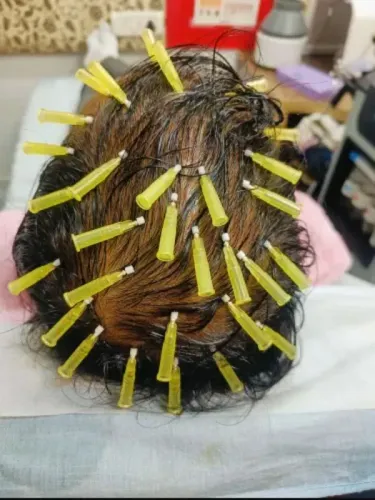
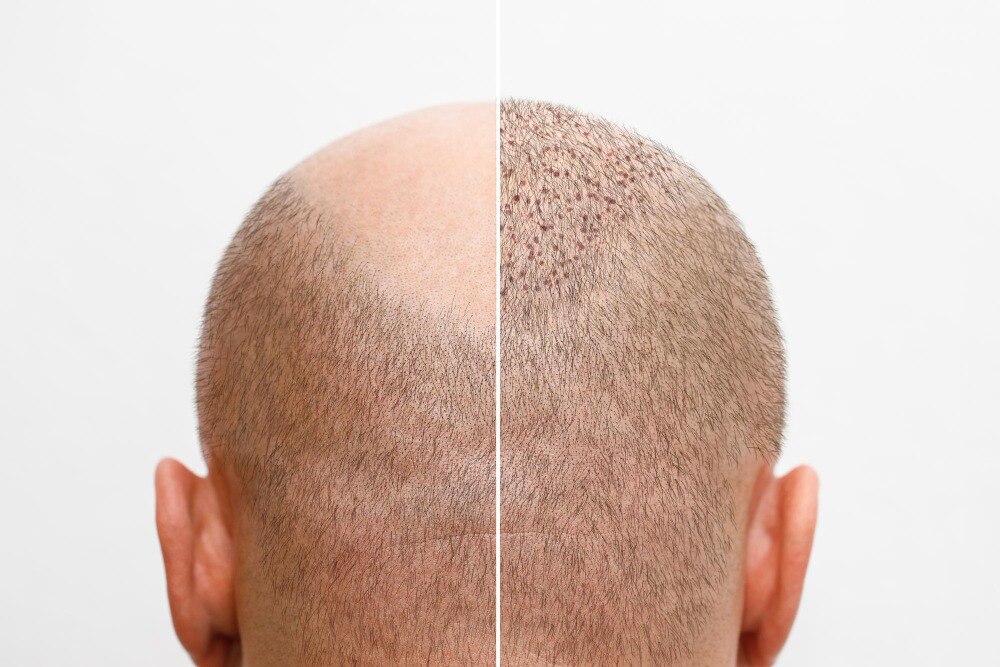
A session begins with photographs, a marked hairline and donor-area shaving, followed by local anaesthesia. The doctor uses a motorised punch to remove individual follicular units from the back or sides of the scalp, makes tiny recipient-site incisions, and places the grafts according to their natural direction. A dressing covers the area afterward.
The practical sequence is:
- Donor hair is trimmed or shaved so the operator can see each follicular unit.
- Local anaesthetic numbs the donor and recipient areas; you remain awake.
- A punch extracts units containing one or more hairs, leaving small circular wounds.
- The team sorts the grafts and places them into prepared sites at the planned angle and density.
- The clinic gives wound-care instructions and explains what to expect during healing.
A graft is not the same as a hair. One graft can contain one to four hairs, so “3,000 grafts” does not mean 3,000 hairs. Ask for the estimated graft count, the expected hair count, and the exact area it will cover—hairline, temples, mid-scalp or crown.
A credible FUE hair transplant in Kharghar plan also shows how many grafts your donor zone can safely spare. Using every available unit to create a dense hairline today can leave too little donor hair for future pattern loss.
Treat a low per-graft price with caution if the clinic has not examined your scalp, diagnosed the cause of loss, proposed a hairline, and explained who performs extraction and implantation.
How a Doctor Decides Whether You Are a Suitable Candidate
An FUE candidate needs a confirmed diagnosis, a usable donor supply and a plan that still looks natural if hair loss continues. The consultation should distinguish androgenetic alopecia from alopecia areata, scarring alopecia, active scalp inflammation and temporary shedding. Transplanting during active scarring or inflammation can produce poor growth and delay the correct treatment.
Before agreeing, require these checks:
1. Examine the scalp and donor zone for follicle density, hair calibre, miniaturisation, scars, inflammation and available donor area. FUE redistributes follicles; it cannot increase the total supply.
2. Review your age, family pattern, medical history, medicines and previous hair treatments. Ask whether minoxidil or, for appropriate men, finasteride could stabilise native hair, including their contraindications and adverse effects.
3. Compare standardized photographs and receive a marked hairline, target coverage area and graft estimate. The plan must explain why that number is suitable and reserve donor hair for future loss instead of spending it all on one dense frontal hairline.
4. Confirm who performs consultation, extraction, recipient-site creation and implantation. Verify the doctor’s medical registration and relevant surgical training, ask how complications are managed, and confirm local follow-up.
A cautious doctor will also test your expectations: transplanted hair does not stop untreated pattern loss, and density has limits. Delay the procedure if the diagnosis is uncertain, shedding is rapidly changing, donor hair is weak, or you expect adolescent density from a finite supply.
How to Compare FUE With FUT, Medicines and Non-Surgical Options
A transplant gives better value when your loss is stable, your donor area is strong, and you want a permanent redistribution of hair. It gives poor value when diffuse thinning is still advancing, scalp disease is active, or you expect childhood density. FUE and FUT use the same limited donor supply; neither stops future miniaturisation.
| Option | Value and commitment | Best fit | Main limitation |
|---|---|---|---|
| FUE | Individual graft extraction; no linear strip scar, but many small wounds and a finite donor supply | Short hairstyles, smaller-to-medium sessions, patients prioritising scar concealment | Higher effort and cost in larger cases; overharvesting can thin the donor area |
| FUT | A strip is removed and closed with a linear scar; it can yield many grafts in one session | Larger sessions, suitable scalp laxity, and patients who keep hair longer | Linear scar and longer incision recovery |
| Minoxidil or finasteride | Ongoing treatment that can preserve or improve native hair without surgery | Early or continuing pattern loss, or someone postponing transplantation | Benefits require continued use; adverse effects and contraindications need medical review |
| PRP, fibres or a hair system | Non-surgical camouflage or density support with repeat appointments or daily use | Mild thinning, temporary coverage, or people avoiding surgery | They do not restore depleted follicles or create permanent density |
If your search is “hair transplant belapur worth it”, compare the consultation rather than the locality or per-graft rate. Ask for a diagnosis, donor-density assessment, standardised photographs, a proposed hairline, graft count, future-loss plan, and the surgeon’s role in extraction and placement.
Be You Aesthetics is worth comparing only if its consultation explains when medicines, PRP, camouflage or no procedure would serve you better. That answer matters more than choosing FUE because it is available nearby.
Related service
FUE Hair Transplant At Be You Aesthetics Clinic, under the expert guidance of Dr. View service → |
Recovery, Shedding and the Timeline for Judging the Result
Do not judge an FUE result after a few weeks. Recovery usually involves scalp tenderness or tightness, swelling, crusting and itching, while the donor area heals from multiple small extraction sites. Follow the clinic’s washing instructions and avoid scratching, strenuous exercise and direct sun exposure until your surgeon clears them.
The implanted hairs often shed during the early postoperative period. This “shock loss” is part of the cycle for many patients; it does not prove that the follicles have failed. New growth is gradual, uneven and easy to mistake for a poor result when viewed too soon.
- Days 1–7: Expect crusts, redness, itching and swelling. Do not pick crusts or rub the grafts.
- Weeks 2–8: Transplanted shafts can shed, leaving little visible change.
- Months 3–6: Early regrowth may appear as fine, sparse hairs.
- Months 6–9: You can assess meaningful improvement in coverage and hairline shape.
- Around 12 months or later: Judge the result more fairly, because density and calibre can continue developing.
Contact the surgeon promptly for worsening pain, spreading redness, pus, fever, persistent bleeding or marked swelling. FUE does not remove risks such as infection, folliculitis, numbness, poor growth or scarring.
Before choosing fue hair restoration in navi mumbai, confirm that active scalp inflammation, alopecia areata, scarring alopecia and temporary shedding have been ruled out. A transplant into an undiagnosed condition can grow poorly and delay the correct treatment.
Frequently asked questions
When is an FUE hair transplant worth the procedure?
FUE provides enough value when you have diagnosed, reasonably stable pattern hair loss, sufficient healthy donor hair and realistic expectations about density and hairline design.
What does the graft number mean in an FUE transplant?
A graft is a follicular unit containing one to four hairs, so the quoted graft number is not the same as the final hair count. Ask how many grafts and individual hairs are planned.
How does a doctor decide whether you are suitable for FUE?
The doctor assesses your diagnosis, hair-loss stability, scalp condition, donor density, family history, likely future loss and whether your expectations match the available donor supply.
How long should you wait before judging an FUE result?
Temporary shedding can occur in the first weeks. New growth develops gradually, and you should judge the result after about 9 to 12 months rather than during early recovery.
Keywords